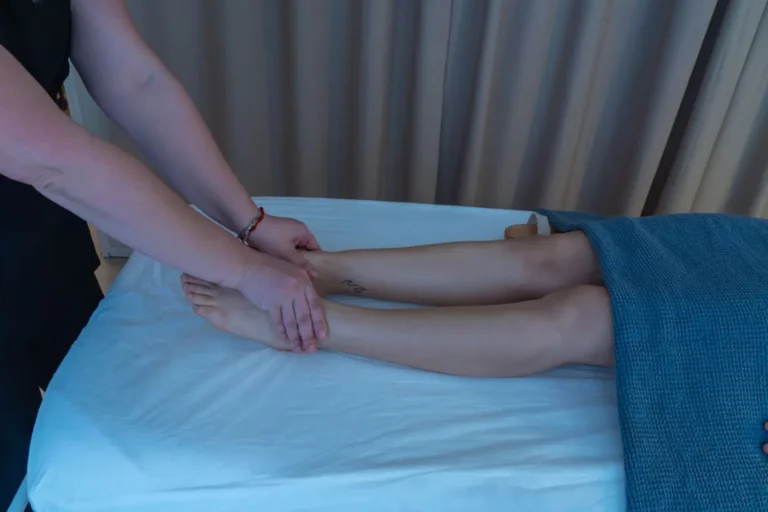
“I can’t sleep because of the pain” is one of the things we hear most often in the clinic. Low back pain at night, a stiff neck in the morning, a shoulder that won’t let you lie on your side. Research shows the link also works the other way – poor sleep makes pain worse. That’s why in rehabilitation sleep isn’t a side issue but part of the treatment.
Below you’ll see what the science shows, which exercises improve sleep the most and how to build a programme that works for both the pain and the night.
Contents
Sleep predicts pain more than pain predicts sleep
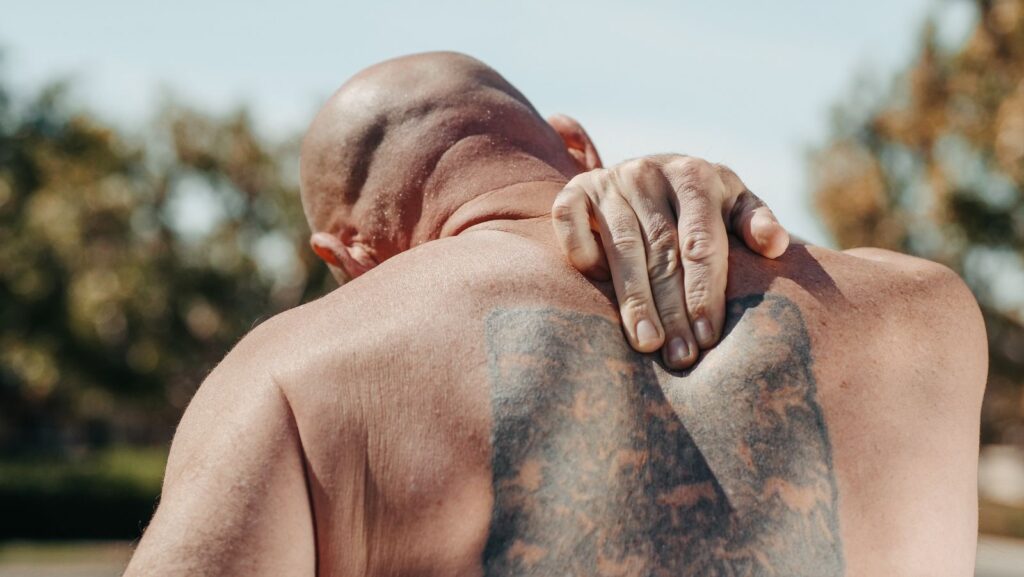
For a long time insomnia was seen simply as a consequence of pain. Today research agrees the relationship is two-way, but with an important nuance: disturbed sleep predicts pain more strongly than pain predicts disturbed sleep (review, 2024).
- In a study of patients with chronic pain, changes in sleep complaints at 3 months predicted changes in pain at 12 months – almost twice as strongly as the reverse (PubMed 26076002).
- Short or fragmented sleep increases pain sensitivity and weakens the brain’s own pain-inhibiting systems. Poor sleep is also a risk factor for post-surgical pain becoming chronic (Front Pain Res, 2025).
The practical takeaway: if we treat only the pain and ignore sleep, we solve only half the problem.
Exercise as a treatment for sleep
Movement is one of the few treatments that act on pain and sleep at the same time. Recent meta-analyses give concrete guidance:
| Study | Findings |
|---|---|
| Wang et al., BMC Public Health, 2025 | All types of exercise improve sleep; Pilates and aerobic exercise perform best. The optimal dose is about 3 h of strength training or about 4 h of walking per week. More is not better. |
| BMC Geriatrics, 2025 | In older adults, combined aerobic and strength training is most effective. |
| Frontiers in Medicine, 2025 | In older adults, even low-intensity and short programmes improve sleep quality. |
| BMJ Evidence-Based Medicine, 2025 | For insomnia, yoga, tai chi, walking and jogging are among the most effective forms. |
| Meta-analysis, 2025 | Water-based exercise improves sleep in chronic back pain and Parkinson’s. |
An honest caveat: a study in chronic low back pain (Sleep Medicine, 2025) shows exercise alone doesn’t always improve sleep enough. That’s why the programme needs to be sleep-focused, not just “include exercise”.
Sleep-focused rehabilitation: what we change

At Omni Health we add sleep as a separate goal in the rehabilitation programme. This means a few concrete things:
- We measure sleep, not just pain. At the start and every few weeks we ask how long it takes you to fall asleep, how often you wake up and how you feel in the morning. If sleep doesn’t improve, the programme is adjusted.
- Strength training + aerobic movement. The combination has the best effect on both pain and sleep. The target is about 3–4 hours of movement per week, spread over most days.
- The right timing. A meta-analysis (Stutz et al., Sports Medicine, 2019) shows that moderate evening exercise doesn’t worsen sleep and even slightly increases deep sleep. The exception is intense training that ends less than an hour before bed. Hard sessions stay in the daytime; evenings are for calm movement.
- Sleeping position for your problem. For low back pain – on your side with a pillow between your knees, or on your back with a pillow under your knees. For neck pain – a pillow that keeps your head level with your chest. For shoulder pain – on the healthy side, with a pillow in front of you to support the sore arm.
- Dosing after exercise. If pain disturbs your sleep after a session, the load was too high and the next session is eased.
Sometimes a restorative massage at the end of the day also helps you relax and fall asleep more easily.
A 15-minute evening routine
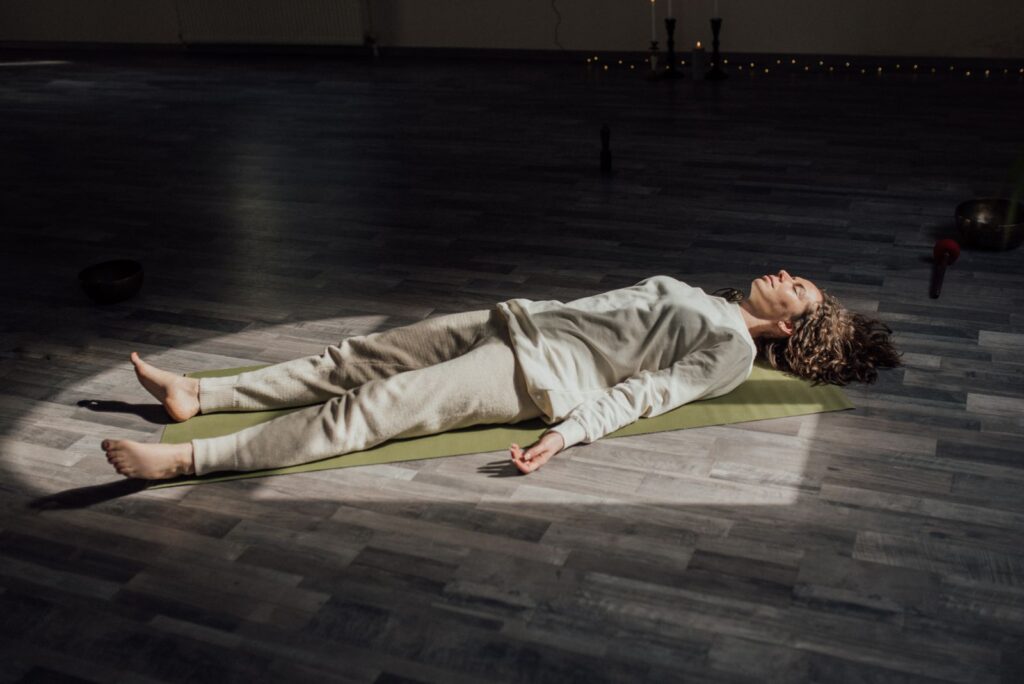
Do it 30–60 minutes before bed.
- Gentle stretching (5 min). Slow movements for the spine and hips: cat–cow, knee to chest lying down, spinal rotations lying down. No pain, no forcing.
- Slow breathing (5 min). Breathe in through your nose for 4–5 seconds, out for 6–7 seconds. The longer exhale helps the body switch to rest mode. Instead of counting, use the free breathing timer by ZHIVETE (in Bulgarian). You can read more about the science of breathing in our article on breathing exercises for low back pain.
- Stillness (5 min). Lie with your eyes closed, attention on the weight of your body on the bed. If a time cue helps, the meditation timer by ZHIVETE counts down without distraction.
And the basics you shouldn’t skip: the same bedtime and wake time, a dark and cool room, no screens for the last half hour.
Useful tools for better sleep
When to seek help
See a physiotherapist if pain regularly wakes you or keeps you from falling asleep for more than a few weeks. See a doctor if the pain is worst at night and doesn’t change with position, if you snore loudly and stop breathing in your sleep, or if insomnia lasts more than 3 months – then the best-proven treatment is cognitive behavioural therapy for insomnia. See also the 5 warning signs of back pain.
At Omni Health in Sofia we build physiotherapy programmes that track not only pain but also sleep – with exercise selection, dosing and advice on positions and routine.
How we can help
Time for action
Don’t delay – book an appointment now and take the path to full recovery!
Contact us by phone for a free consultation
Frequently asked questions
What can I do about back pain at night?
Try lying on your side with a pillow between your knees or on your back with a pillow under your knees, a calm evening routine and regular movement during the day. If back pain at night doesn’t change with position, see a doctor.
Why is back pain at night worse when I sleep poorly?
Disturbed sleep increases pain sensitivity and weakens the brain’s own pain-inhibiting systems. That’s why treating back pain at night includes looking after your sleep.
Can I exercise in the evening?
Yes. Moderate evening exercise doesn’t worsen sleep. Only avoid intense training less than an hour before bed.
Sources
- Relationship Between Sleep Disturbances and Chronic Pain: A Narrative Review, 2024.
- The bidirectional relationship between sleep complaints and pain: analysis of data from a randomized trial.
- At the Intersection of Pain and Sleep. Front Pain Res, 2025.
- Wang H et al. The best approaches and doses of exercise for improving sleep quality. BMC Public Health, 2025.
- Optimal exercise type and dose to improve sleep quality in older adults. BMC Geriatr, 2025.
- Effects of exercise interventions on subjective sleep quality in older adults. Front Med, 2025.
- Effects of various exercise interventions in insomnia patients. BMJ Evid Based Med, 2025.
- Effects of Aquatic Exercise on Sleep Quality in Patients with Chronic Diseases, 2025.
- Effects of different modes of exercise on sleep quality in adults with chronic low back pain. Sleep Med, 2025.
- Stutz J, Eiholzer R, Spengler CM. Effects of Evening Exercise on Sleep in Healthy Participants. Sports Med, 2019.