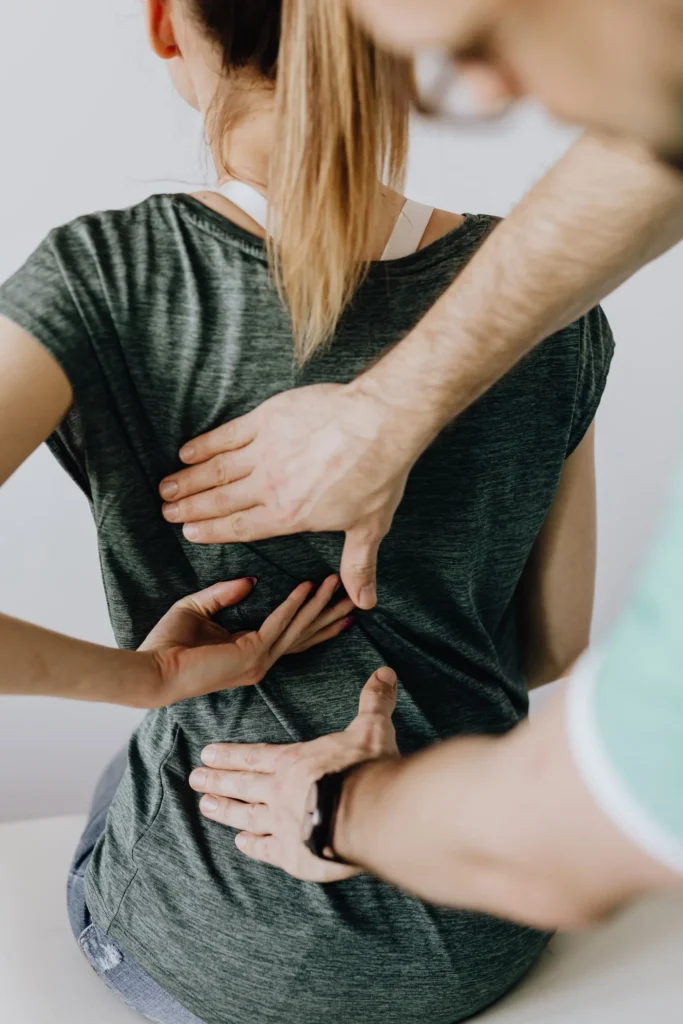
Pain in your lower back, neck or shoulder that won’t go away?
Manual therapy at Omni Health, Reduta district – hands-on treatment aimed at the cause, not just the spot that hurts.
We use precise joint and spinal mobilisations, tendon and ligament techniques and muscle work. Every therapy starts with an assessment, and afterwards we repeat the tests so you can see what has changed.
Or call 088 673 6647
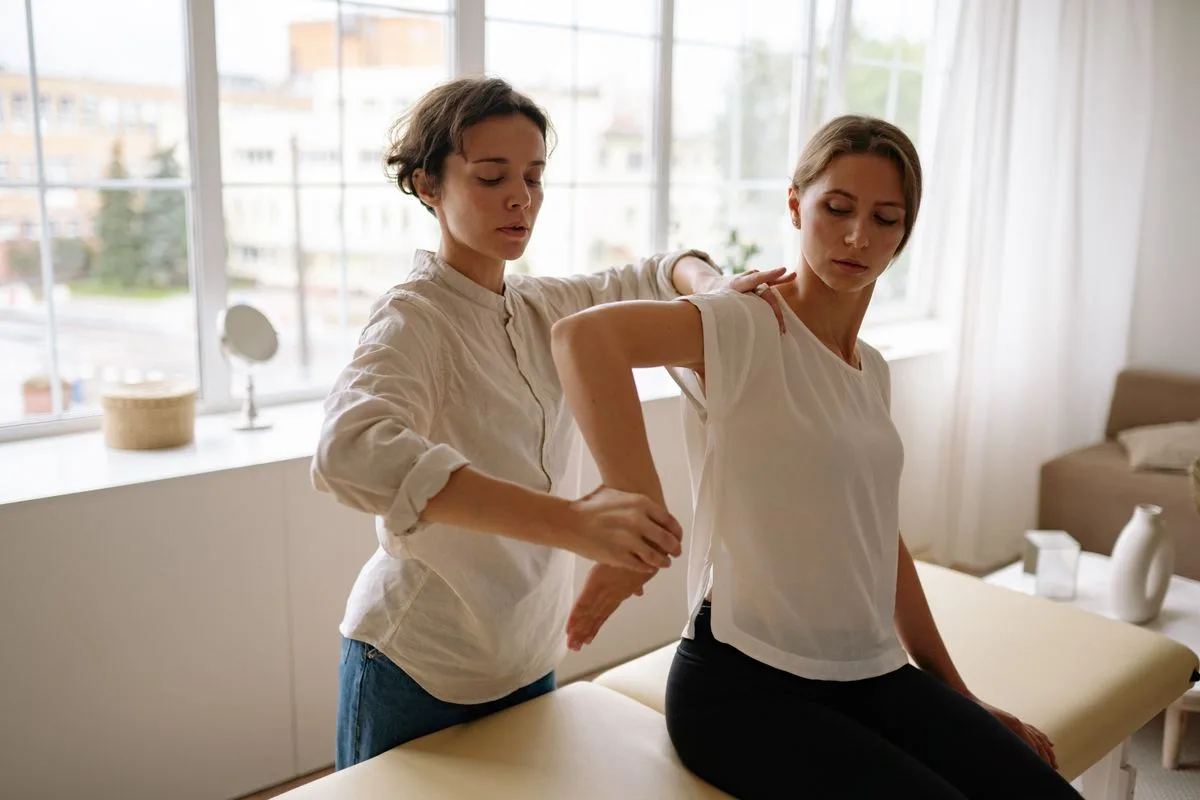
When manual therapy helps
- Low back pain – acute or chronic, with disc protrusion and herniation, after an assessment and in the absence of red-flag symptoms. Herniated disc – read more
- Neck pain and stiffness – from sitting at a computer, stress, or headaches that start in the neck.
- Shoulder – pain when lifting the arm, rotator cuff problems, frozen shoulder. Frozen shoulder – read more
- Tendons and ligaments – tennis elbow, Achilles tendon, knee and ankle after a sprain. Tennis elbow – read more
- Pain between the shoulder blades – often referred pain from the neck, not “plexitis”.
- After injury or surgery – when the joint is “locked” and exercises alone don’t give results.
Numbness in the groin, loss of bladder control or increasing leg weakness need urgent medical assessment. Warning signs of back pain
How the therapy works
Every manual therapy session with us follows the same four steps.
Assessment
A conversation about the problem and tests of movement, strength and the nervous system to find the cause.
Therapy
We choose techniques based on the assessment and work within what you can comfortably tolerate.
Retest
We repeat the tests right after the therapy to see what has changed.
Plan
Home exercises and a clear idea of how many sessions you need.
From the “Biomechanic” podcast · 2 min. (in Bulgarian)
Manual therapy by Cyriax: why assessment comes first
On the “Biomechanic” podcast Kaloyan talks with Dr. Hristo Dimitrov, an international instructor in the Cyriax method. In this excerpt he explains the difference between a bone-setter, a chiropractor and a physiotherapist: diagnosis. Without it, a “crack” can be dangerous.
“There aren’t a thousand ways to hurt your back. When you see things that don’t fit the usual clinical picture, the thinking has to start about why.”
That’s why every manual therapy session with us starts with an assessment. Watch the full episode below (in Bulgarian)
The methods we use
Established manual therapy concepts, chosen for the problem rather than one technique for everyone.
Maitland mobilisations
Rhythmic, graded movements in the joints and spine. The dose is set by the assessment and the body’s response.
Cyriax
Deep transverse friction of tendons and ligaments, and manipulations only when the assessment justifies them.
Osteopathic techniques
Soft techniques for joints, fascia and muscles that reduce tension and improve movement.
Trigger points
Work on painful points in muscles that refer pain elsewhere, for example from the neck to the head.
Manual therapy gives the best result combined with kinesitherapy: the hands free up the movement and the exercises keep it.
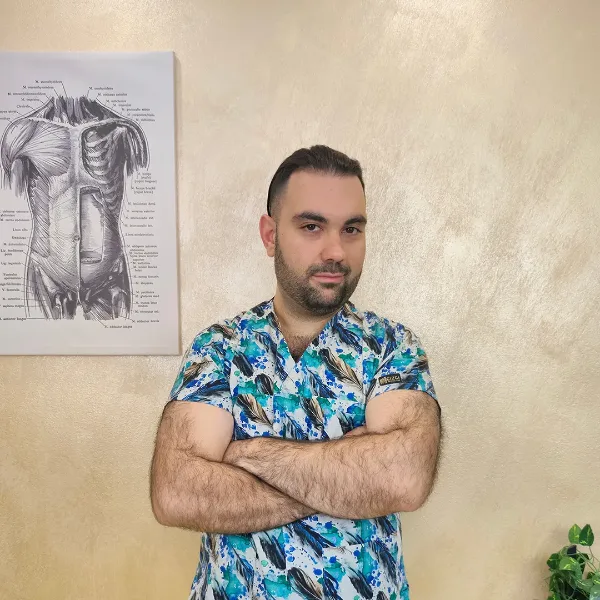
Kaloyan Popov
Rehabilitation therapist · musculoskeletal and neurological rehabilitation
He has worked in rehabilitation for 7 years, focusing on back, neck and joint pain, sports injuries and recovery after surgery. He also works with patients with neurological conditions.
Before that he trained in karate, swimming and rugby for 10 years, and has practised yoga for 16 years. So he knows training load and injuries from the inside and works with many athletes and active people.
His first training was in orthopaedic medicine by the Cyriax method, which he has repeated several times. He hosts the “Biomechanic” podcast, where he talks with instructors and specialists in manual therapy.
Methods and training: Maitland, Cyriax, McKenzie, neurodynamics, osteopathic techniques, trigger points, instrument-assisted therapy, kinesio taping.
“Biomechanic” podcast · ep. 1 · 56 min. (in Bulgarian)
Manual therapy by Cyriax with Dr. Hristo Dimitrov
Kaloyan talks with the international instructor in orthopaedic medicine about how a diagnosis is reached, when manual therapy helps and when cracking is dangerous.
Jump straight to the topic you’re interested in:
Manual therapy prices
Physiotherapy assessment
30 €
30 minutes – assessment of pain, movement and strength and a therapy plan.
Book nowPayment is on site. If you are coming for the first time, we start with an assessment.
Frequently asked questions
Some techniques may be slightly uncomfortable, but we work within what you can tolerate. The force is dosed according to your body’s response and you can always ask us to stop.
It depends on the problem. With acute pain there is often a clear change after 1–3 sessions, while chronic problems need a longer plan combined with exercises. We tell you after the assessment.
Massage works mainly with the muscles. Manual therapy also works with the joints, spine, tendons and ligaments and targets a specific cause found at the assessment.
No. If you have an MRI, X-ray or medical report, bring it to the assessment.
After a recent fracture, acute inflammation, advanced osteoporosis or red-flag symptoms. That’s why we always start with an assessment and refer you to a doctor if needed.
At 33 Zhivko Nikolov St., Reduta district, Sofia – near Geo Milev and Poduyane.
Let’s find the cause of your pain
Book an assessment online or call us. We’ll honestly tell you whether manual therapy is the right choice for you.
Book nowHave a question? Call for a free phone consultation, write on Instagram or Messenger
See also: Kinesitherapy · Rehabilitation · Massages