Why do so many people go through course after course of therapy with no real result? In the first episode of the “Biomehanik” podcast, Kaloyan Popov of Omni Health talks with Dr Hristo Dimitrov, PhD in physiotherapy and international instructor in orthopaedic medicine according to the Cyriax method. The topic is simple and uncomfortable: pain is rarely where we feel it, and without an accurate diagnosis even the most expensive therapy is a shot in the dark.
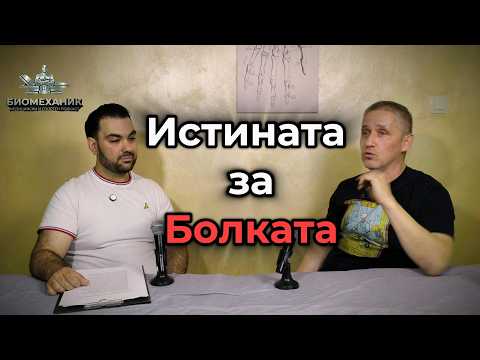
You can also watch the full episode (in Bulgarian) on the Biomehanik YouTube channel. For more on the life and work of the English orthopaedic physician, see the Wikipedia article on James Cyriax.
Contents
Key takeaways: 7 things from the conversation
- Diagnosis matters more than technique. In Cyriax’s own words, techniques can be learned in a day, while diagnosis takes a lifetime.
- An MRI does not tell the whole story. Many people without pain have disc bulges on the scan, while others in terrible pain have a “clean” result.
- “Plexitis” between the shoulder blades is usually not plexitis. It is most often pain referred from the neck.
- Knee pain can come from the hip or the lower back.
- A mechanical problem needs mechanical treatment: manual therapy and movement, not just electrotherapy and ultrasound.
- Cracking without an examination can be dangerous. There are conditions in which manipulation must not be done.
- The patient has to do their part too. Passive therapy without a change in habits gives only a temporary effect.
Who was James Cyriax
James Cyriax was an English physician known as “the father of orthopaedic medicine”. He was active from 1937 to 1985 and built a coherent system for the diagnosis and non-surgical treatment of the soft tissues and the spine. Asked what he believed in, he answered: “I believe in orthopaedic medicine.”
Dr Dimitrov explains how Cyriax tested where low back pain comes from. According to him, Cyriax gave more than 40,000 injections of a weak anaesthetic into the sacral canal. The solution reaches the disc and the dura mater, but not the facet or sacroiliac joints. In most patients the pain disappeared. This led him to conclude that around 90% of mechanical low back pain comes from a conflict between the intervertebral disc and the dura.
How a Cyriax diagnosis is made
“Good therapists have big ears and open eyes,” says Dr Dimitrov. That means listening to the patient and not putting words in their mouth. If you ask “Does it hurt here?”, the answer will almost always be “yes”. So the therapist asks neutral questions, such as “Does this test change anything?”.
Example: a patient with left-sided low back pain bends backwards. If the pain spreads down the leg, it “peripheralises” – it moves away from the centre of the spine. This is a valuable sign that the problem is getting worse. Ask the wrong question and this information is lost.
The diagnosis is put together like a puzzle:
- History: the story of the problem, how it started and how it changes.
- Functional tests: active, passive and isometric movements that show which structure is affected.
- Location and behaviour of the pain: whether it stays in one place or moves.
- Imaging: useful, but only one piece of the puzzle.
- Retest: after each treatment we repeat a positive test. That way we know whether the therapy worked, rather than having just “massaged” the problem.
MRI and disc herniation
More and more patients arrive with an MRI and a diagnosis of “disc herniation” or “protrusion”. But scans of people without pain also often show bulges and narrowing. The opposite happens too: someone with pain at 10 out of 10 and an almost clean scan. That is why Dr Dimitrov insists on functional diagnosis and proper testing first, with the scan as a supplement. Read more in our article on herniated discs.
Machine-based physiotherapy or manual therapy?
Clinics today are full of lasers, shockwave and other devices costing tens of thousands. Patients often ask for them because they look modern. Cyriax’s logic is simple: if the problem is mechanical, it needs a mechanical intervention. That is what manual therapy (manipulation and mobilisation), traction and movement provide. Manual therapy and traction have been used for generations, while the evidence for many of the devices remains limited.
Still, no technique does the job on its own. If someone sits hunched over all day, the pain will come back. That is why at Omni Health manual therapy always goes together with physiotherapy and home exercises.
Bonesetter, chiropractor or physiotherapist?
Bulgaria has a long tradition of folk bonesetters, and chiropractic came from the West. Dr Dimitrov does not dismiss them: if people trust them, they must sometimes help. The fundamental difference is in diagnosis. If a therapist cannot form a clear hypothesis about what is causing the pain, they are just another “bone-setter”.
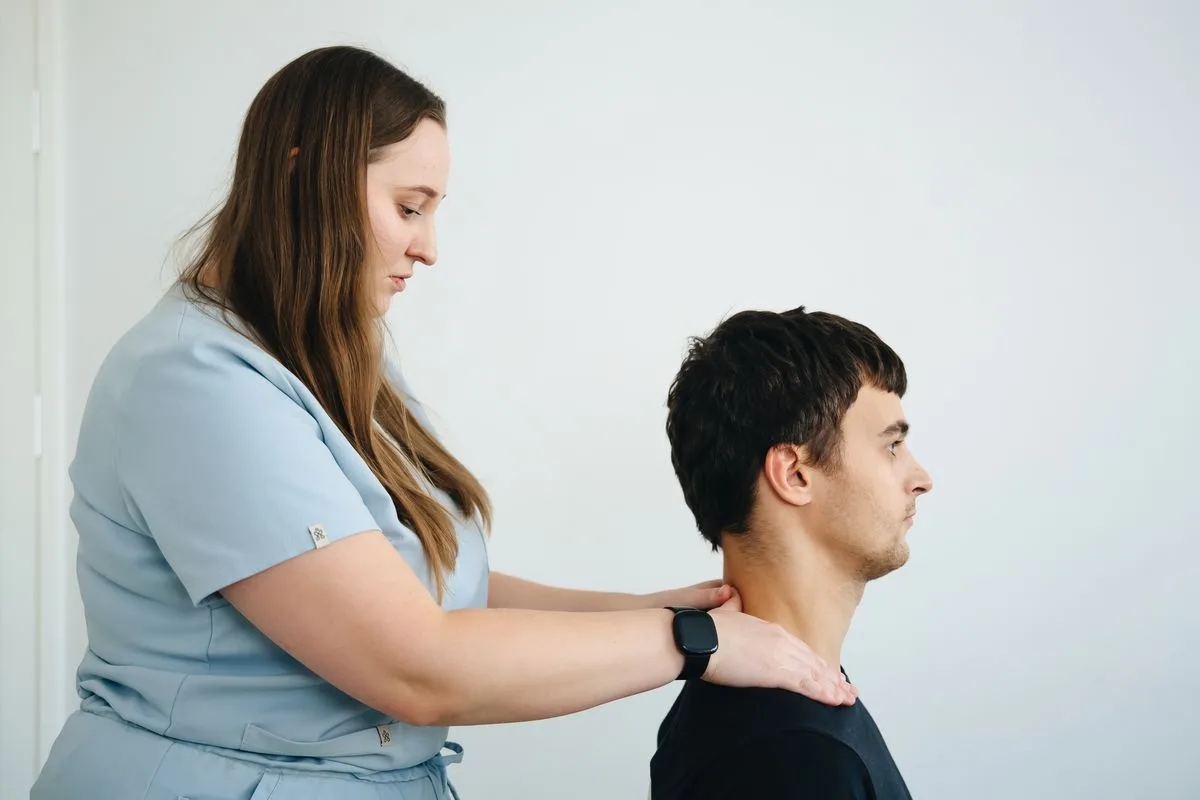
Orthopaedic medicine sits somewhere in the middle. It does not blame the spine for everything, but it uses manipulation when the examination justifies it. Lumbar manipulation is done only when clinical tests point to a conflict between the disc and the dura mater.
When cracking is dangerous
“There aren’t a thousand ways for your back to hurt – there are a few main ones,” says Dr Dimitrov. When something does not fit the usual picture, a red light should go on. People with metastases in the spine also end up on the treatment table. That is why we always ask about a history of cancer, unusual pain and other warning signs.
The stronger the pressure on the nerve root, the more serious the symptoms:
- Mild pressure: pain.
- Stronger pressure: pain plus numbness or pins and needles.
- Severe pressure: muscle weakness, for example foot drop.
Increasing leg weakness, numbness in the groin or problems holding urine require an urgent medical examination – not next week. Read more about these symptoms in the article Back pain: 5 warning signs.
Low back or neck pain that won’t go away? Start with an examination.
Book onlineWhen rest and medication are the better choice
Sometimes a patient arrives in such an acute phase that it takes them half an hour to turn over on the table. At that point inflammation is in charge. It is wiser to take the prescribed medication for a few days and keep moving within what is tolerable. Manual therapy comes once the acute phase has passed. The same applies to traction: in an acute patient it may bring relief during the session but make things worse afterwards.
Can a herniated disc be “put back in place”? The body has a mechanism for spontaneous recovery and can reabsorb extruded material. But if the disc’s outer ring is torn, traction cannot “push” the material back in. If five sessions bring no change, the method is not working and a different approach is needed.
“Plexitis” and referred pain
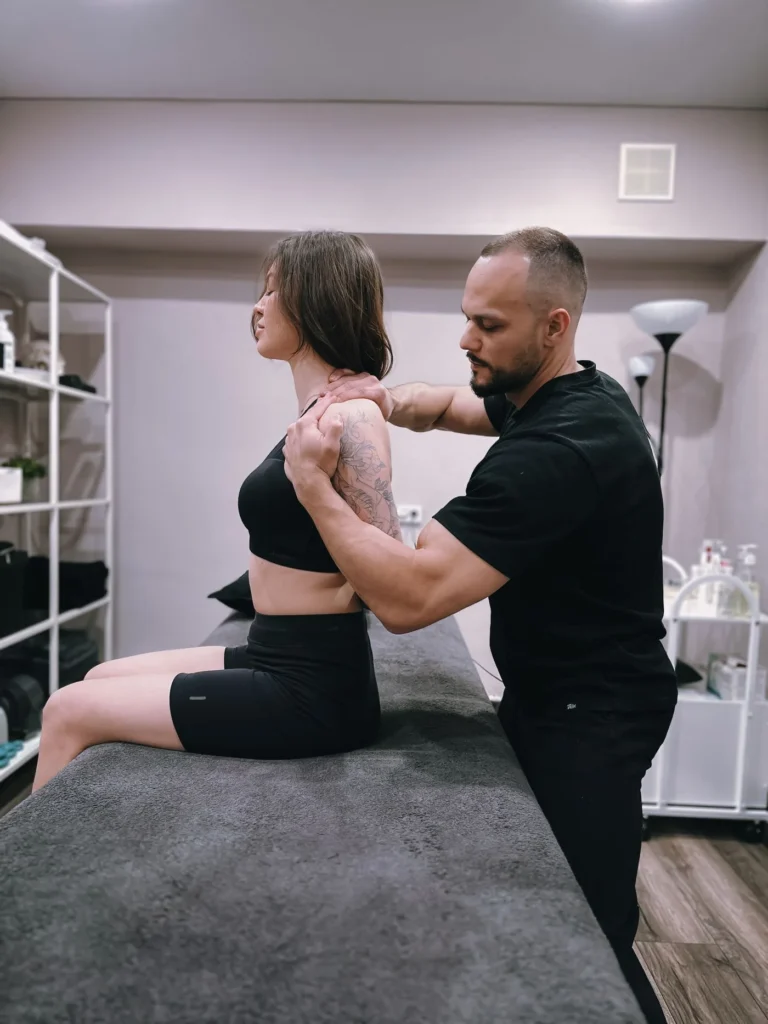
One of the most common “diagnoses” in Bulgarian clinics is “plexitis”: pain between the spine and the shoulder blade. The brachial plexus, however, sits at the front, under the collarbone, and supplies the arm. Pain between the shoulder blades is most often referred – from pressure on the dura mater or from the facet joints in the neck.
The principle of referred pain is at the heart of Cyriax’s work. Soft tissues refer pain within their own dermatome – the skin area supplied by the corresponding spinal segment. The dura mater is the exception: it can refer pain across up to eight dermatomes. That is why the “spot” the patient points to often disappears after a neck manipulation. It is not a trigger point in the muscle but referred pain.
When the knee hurts but the problem is elsewhere
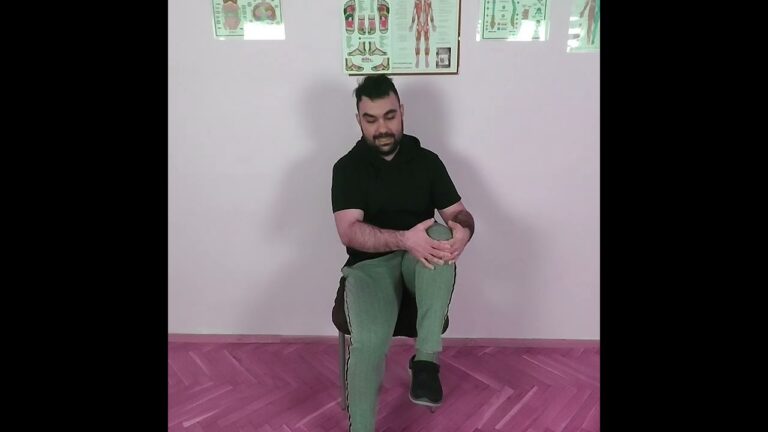
Knee pain is often local, especially in runners. The most common source of referred knee pain, however, is the hip joint, via the L3 dermatome. That is why an examination for knee pain also includes the hip and the lower back.
Cyriax deep friction: massage with a specific target
One of Cyriax’s best-known techniques is deep transverse friction. Unlike a classic massage for relaxation or sports performance, it is applied precisely to the injured structure found during the examination – a tendon, ligament or muscle.
After an injury, cross-adhesions form in the tendon and reduce its elasticity. Friction moves the tissue crosswise, prevents and breaks down these adhesions and aligns the fibres. It helps with:
- tendon injuries in the shoulder, for example of the supraspinatus;
- ankle sprains, together with balance and proprioception exercises;
- the coronary (meniscotibial) ligament of the knee;
- partial muscle tears in the early phase, when active movement is still risky.
Friction is not applied directly over a haematoma, over calcifications or to a complete tear, which is a case for a surgeon. According to Dr Dimitrov, when applied correctly it significantly shortens recovery.
The right mindset for treatment
The message to fellow therapists is to open their eyes and ears. The message to patients is not to believe in miracle cures and to take an active part. Therapy is a partnership: if one side gives nothing, the result does not come. Many people live with pain for years and start to believe they are “broken”. Active therapy gives them back the confidence that they can get better.
Never accept pain as your new normal.
More on the topics from the conversation: sciatica, nerve mobilisation and tennis elbow – where Cyriax deep friction is a key method.
Frequently asked questions
What is the Cyriax method?
A system for the diagnosis and non-surgical treatment of the soft tissues and the spine, created by the English physician James Cyriax.
What is deep transverse friction?
A massage technique applied precisely to an injured tendon, ligament or muscle to align the fibres and limit adhesions.
Is cracking the back dangerous?
Without an examination it can be risky. Manipulation is done only when the examination shows it is appropriate and there are no warning signs.
Do I need an MRI before manual therapy?
Not always. The functional examination comes first; an MRI is useful when a serious problem is suspected or the picture is not typical.
Where can I get Cyriax manual therapy in Sofia?
At Omni Health in Reduta, Sofia, where after an examination we work with Cyriax and Maitland techniques.
Episode chapters
- 0:00 Introduction
- 1:38 Who Cyriax was and what he discovered
- 6:36 Getting to the root of the problem
- 11:22 MRI and patients
- 12:07 Machine-based physiotherapy
- 14:22 The role of the therapist
- 18:02 Bonesetters, chiropractic and professionals
- 25:33 When cracking is dangerous
- 27:39 When to rest and take medication
- 35:54 When the knee hurts but the problem is in the back
- 39:49 Does massage help?
- 43:08 Cyriax deep friction
- 49:58 The right mindset for treatment
Cyriax manual therapy in Reduta, Sofia
At Omni Health every treatment starts with an examination and ends with a retest, exactly in line with the principles from the conversation. We work with Maitland mobilisations, Cyriax techniques and deep friction, and McKenzie exercises. If you have low back, neck, shoulder or knee pain that won’t go away, read more about manual therapy or book an appointment.
Pain that won’t go away?
Book an examination at Omni Health in Reduta, Sofia. We will find the cause and tell you honestly whether manual therapy is the right choice.
Contact us by phone for a free consultation
This article is for information only and does not replace a medical examination.